
- Share
- Share on Facebook
- Share on LinkedIn
Communiqué, Publication / Research
On December 11, 2025
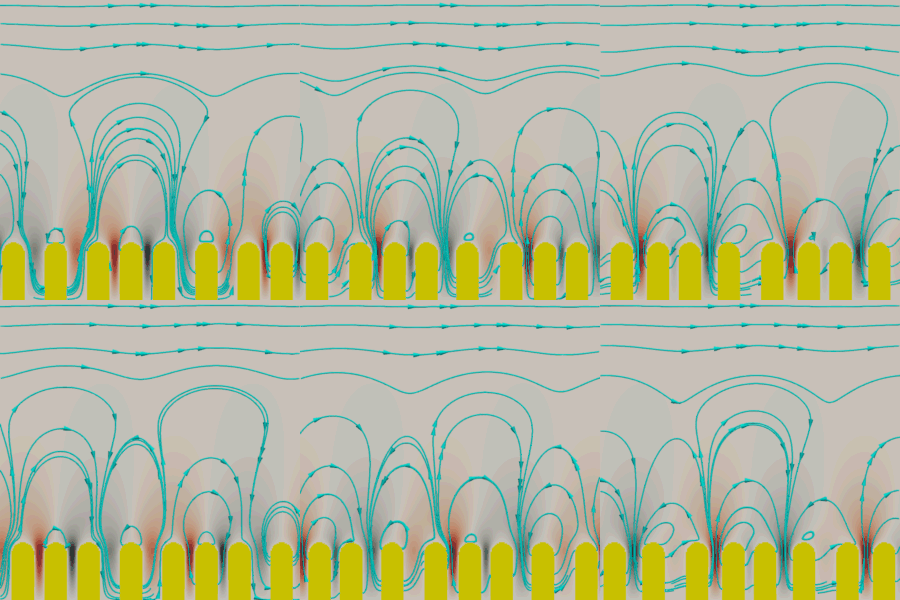
As part of the ANR TransportGut project, which aims to understand how the movements and structure of the digestive tract influence the transport of nutrients and particles, work carried out at the Laboratoire Rhéologie et Procédés, TIMC, and the Laboratoire Jean Perrin has focused on what happens very close to the intestinal mucosa, where fine elongated microstructures rise: the villi.
The objective was to determine whether these microscopic structures play a purely passive role in absorption, or whether they can instead actively contribute to the generation of fluid flows.
Inspired by the pendular contraction waves observed in the small intestine, the researchers simulated a channel lined with villi subjected to out-of-phase oscillations. The study, published in the Journal of Fluid Mechanics, shows that these movements create a contraction wave propagating between the villi and inducing a complex fluid flow. The simulations reveal the formation of a mixing layer above the villi, as well as the emergence of a mean flow oriented opposite to the direction of wave propagation — a surprising behavior compared with classical peristaltic flows.
These results illustrate how microscopic geometry and local dynamics can profoundly modify exchanges at the mucosa–lumen interface. They open new perspectives for a better understanding of intestinal transport and for the design of biomimetic devices inspired by the digestive tract.
Date
Référence
Vernekar, R., Ahmad, F., Garic, M., Yánez Martín, D. I., Loverdo, C., Tanguy, S. & de Loubens, C. (2025). Hydrodynamics in a villi-patterned channel due to pendular-wave activity. Journal of Fluid Mechanics, 1024, Article A9.
Comment les microstructures de l'intestin grêle agissent sur le transport des nutriments ? sur CNRS Ingénierie.
Contact
Clément de Loubens (LRP) : clement.de-loubens univ-grenoble-alpes.fr (clement[dot]de-loubens[at]univ-grenoble-alpes[dot]fr)
Collaborations
Equipe PRETA - TIMC , Grenoble
Laboratoire Jean Perrin, Paris
- Share
- Share on Facebook
- Share on LinkedIn