
Interfacial gelation of biopolymers in the context of solid biofoam processing
- Share
- Share on Facebook
- Share on LinkedIn
Emploi
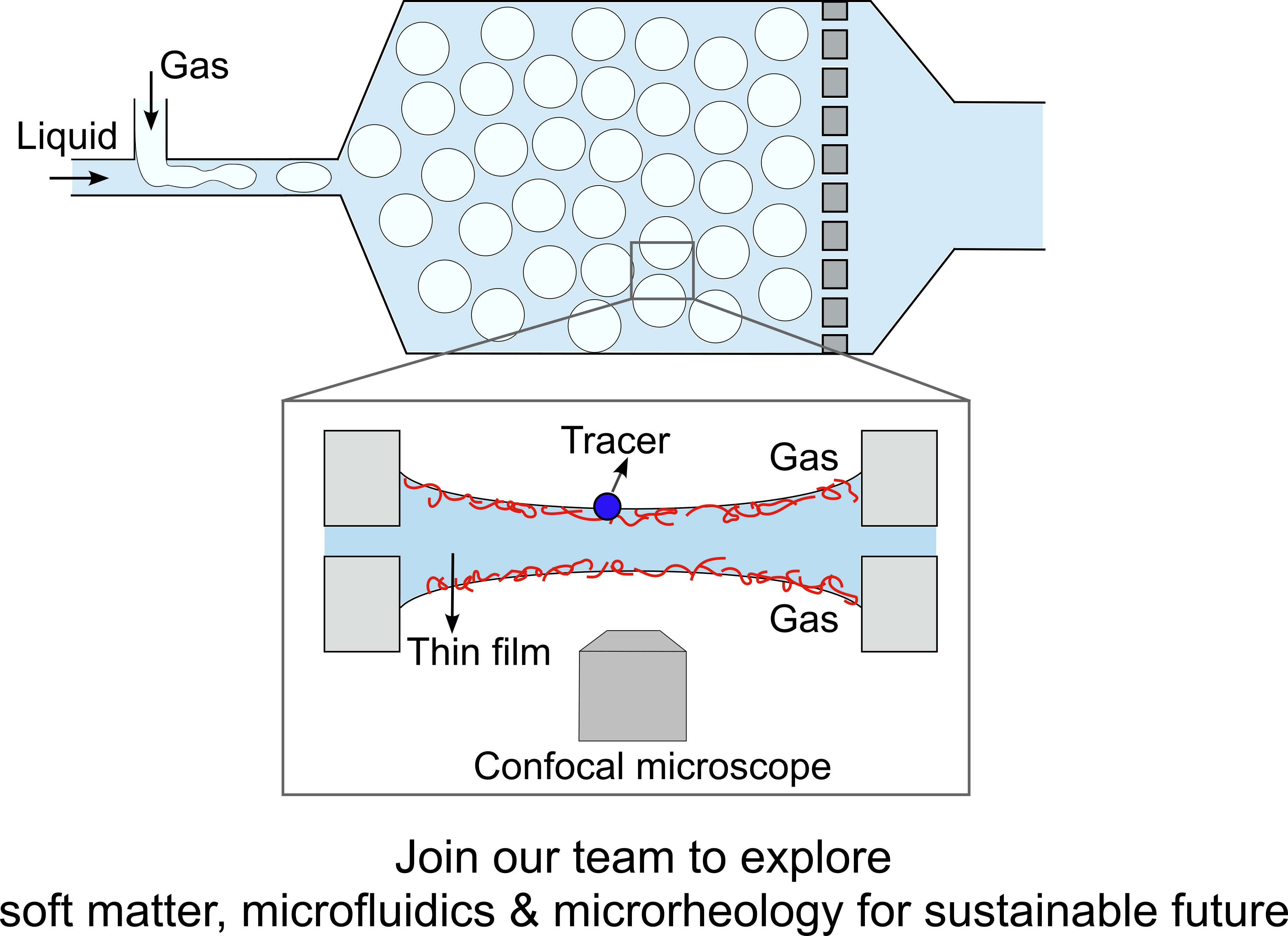
Foams are everywhere—from packaging and insulation to protective materials—because they are lightweight, porous, and excellent at absorbing energy. Today, however, most foams are made from petroleum-based plastics, raising serious environmental concerns. This PhD project aims to address challenges in developing eco-friendly foams made from natural materials.
In this project, liquid foams are used as the precursors for controlling the architecture of the final biofoams. A critical bottleneck lies in the weak mechanical strength of the liquid foams: bubble coalescence, coarsening, and film drainage often cause the structural collapse. The core idea of this PhD project is to prevent these destabilization processes by carefully “gelling” the bubble interfaces and the thin films within foams.
The PhD will explore how this gelation works at the gas-liquid interfaces and compete with bulk gelation occurring in the thin liquid films, and how the knowledge learned can be harnessed to control porous structure of biofoams. The project will develop a microfluidic-based microrheology platform to directly probe gelation kinetics under confinement in foams.
The candidate will join the Soft Matter Physics and Engineering team at LRP, with close collaboration with a physicochemistry laboratory CERMAV. The host offers hands-on training in soft matter physics, materials science, and advanced experimental techniques. The project is ideal for students curious about soft matter and motivated to contribute to a greener and more sustainable future.
APPLICATION
This PhD position is funded by a 3-year contract, starting in autumn 2026. To apply, please submit your application via the ADUM platform before April 10, 2026.
SUPERVISION TEAM
Hugues Bodiguel, Kaili Xie
- Share
- Share on Facebook
- Share on LinkedIn