
Formulation/flow relationships: towards continuous manufacturing processes of biosourced foams with controlled structure
- Share
- Share on Facebook
- Share on LinkedIn
Emploi
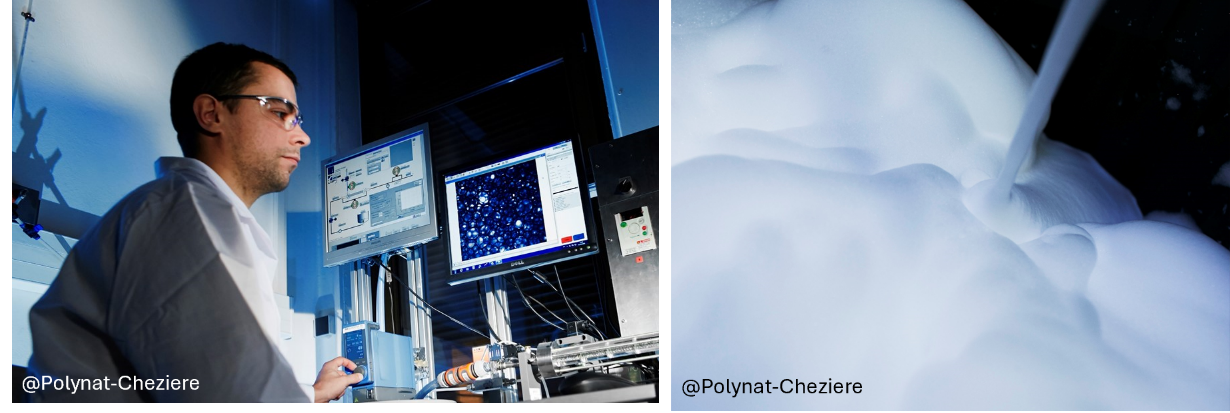
This PhD project aims to develop continuous, scalable manufacturing processes for biobased foams with controlled structure, addressing the urgent need to replace petro-based materials with sustainable alternatives. By leveraging the gelation properties of biopolymers, the research will focus on stabilizing gas-liquid interfaces and optimizing foam structure to prevent collapse during production. The work bridges soft matter physics and process engineering, offering a unique opportunity to contribute to eco-friendly materials for packaging, insulation, and lightweight applications.
Scientific Context and Objectives
This PhD project focuses on the development of continuous manufacturing processes for biobased foams with controlled structure, addressing the challenge of replacing petro-based materials in a context of resource scarcity and recycling constraints. Biobased foams are increasingly relevant in sectors such as packaging, insulation, and lightweight materials due to their environmental benefits (biodegradability, low carbon footprint) and economic advantages (renewable resources).
The objective is to optimize foaming, stabilization, and solidification processes to prevent structural collapse and ensure reproducible, high-performance materials. The project will explore the relationship between formulation, flow dynamics, and final foam properties, combining soft matter physics and process engineering.
Research Program
The PhD candidate will:
- Optimize formulations using biopolymers (e.g., pectin, cellulose) to stabilize gas-liquid interfaces and enhance foam structure.
- Develop and characterize processes from microfluidic to pilot scales, using real-time imaging and rheological analysis.
- Correlate gelation kinetics, solidification, and mechanical properties to enable industrial-scale production.
- Collaborate with interdisciplinary teams and leverage advanced experimental platforms at the Rheology and Processes Laboratory (LRP, CNRS/Grenoble INP).
Profile and Required Skills
Master’s degree or engineering diploma (Bac+5) in Process Engineering, Soft Matter Physics, or related fields. Strong experimental skills and interest in hands-on research. Background in physico-chemistry, formulation, or microfluidics is advantageous. Upper-intermediate English proficiency (written and oral) for scientific communication.
Working Environment
- Facilities: Access to microfluidic platforms, rheometry, and advanced imaging at LRP.
- Collaborations: Partnerships with CERMAV, Centre Technique du Papier (CTP), and national/international research groups (Carnot Polynat, Labex TEC 21).
- Supervision: Regular meetings with a multidisciplinary team of three advisors and external thesis committee.
- Opportunities: Participation in international conferences, publications in high-impact journals, and potential patent filings.
APPLICATION
This PhD position is funded by a 3-year contract, starting in autumn 2026. To apply, please submit your application via the ADUM platform before April 10, 2026.
SUPERVISION TEAM
Clément de Loubens, Emeline Talansier, Thomas Podgorski
- Share
- Share on Facebook
- Share on LinkedIn