
- Share
- Share on Facebook
- Share on LinkedIn
Communiqué, Publication / Research
On March 9, 2026
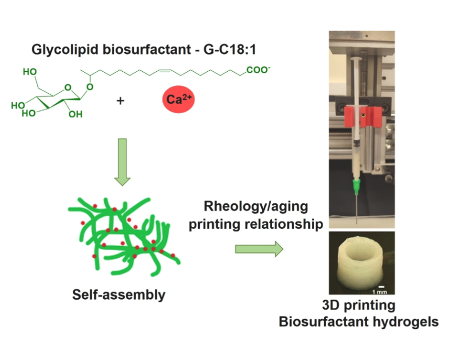
How do the rheological properties of bio-based glycolipid hydrogels determine their performance in extrusion-based 3D printing?
In a recent article published in Colloids and Surfaces A: Physicochemical and Engineering Aspects, researchers from LRP and LCMCP show how the rheological properties of bio-based glycolipid hydrogels determine their performance in extrusion-based 3D printing. The study focuses on supramolecular hydrogels formed by the association of the microbial glycolipid G-C18:1 with calcium ions, considered as bio-based and biocompatible materials for the fabrication of soft structures.
The work establishes a formulation–rheology–process map that identifies printability windows and shows that the quality of printed objects results from a subtle balance between gel structuring, flow behavior, and structural recovery after extrusion. It thus highlights the central role of rheology in controlling printing fidelity.
The study also demonstrates that material aging is a key parameter for improving printing performance, and that adjusting the formulation can accelerate this evolution. Beyond the specific system investigated, this work provides a useful framework for the development of bio-based supramolecular bioinks for 3D printing.
Date
Contact
Yahya Rharbi (LRP) : yahya.rharbi univ-grenoble-alpes.fr (yahya[dot]rharbi[at]univ-grenoble-alpes[dot]fr)
Référence
Elizangela Hafemann Fragal, Niki Baccile, Yahya Rharbi, Rheological optimization and aging-driven performance of glycolipid-based hydrogels for high-fidelity 3D printing, Colloids and Surfaces A: Physicochemical and Engineering Aspects 740 (2026) 140179. DOI: 10.1016/j.colsurfa.2026.140179
- Share
- Share on Facebook
- Share on LinkedIn