
Offre de stage
- Imprimer
- Partager
- Partager sur Facebook
- Partager sur X
- Partager sur LinkedIn
Emploi, Formation, Recherche
Project
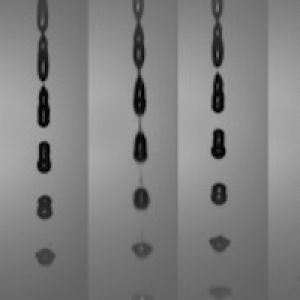
Rheodrop develops an innovative approach to rheological characterization from jet/droplet observations (dynamics, morphology, experimental signatures). The goal is to turn these signatures into quantitative indicators with strong scientific value and clear industrial relevance.
Why this internship is attractive
You will join a hands-on, fully operational experimental setup at LRP, with close support from the technical staff and regular interactions with the research team throughout the campaigns. The internship is mostly experimental (jets/droplets, imaging, protocols, repeatability) and can naturally expand toward more data analysis / image processing depending on your background and growing autonomy.
Main tasks (mostly experimental)
- Prepare and run experiments on jet/droplet benches (setup, tuning, protocols, quality control, repeatability).
- Acquire experimental data (including imaging) and record complete metadata (operating conditions, fluids, etc.).
- Curate, label and structure datasets to ensure traceability and robustness.
- Perform first-level analyses (geometric/dynamic measurements, stability indicators, comparisons and summaries).
- Depending on level and autonomy: fluid characterization (as available), analysis scripts (Python/Matlab), image processing and feature extraction.
Candidate profile
Open to technician-oriented (applied bachelor) or engineer-oriented (MSc/engineering school) students. We are looking for someone who is:
- Hands-on and rigorous in lab practice.
- Careful with documentation and traceability.
- Able to progressively gain autonomy.
- A team player with clear, simple communication.
Python / image processing / data analysis skills are a plus (not required).
After the internship
If successful, the goal is to offer a fixed-term contract (CDD) of up to 12 months to continue the project (up to ≈ 2700€ gross monthly salary).
Laboratory access (ZRR)
The LRP is located in a French Zone à Régime Restrictif (ZRR, restricted-access research zone). Candidates who are nationals of countries outside the EU/EEA must obtain prior administrative clearance, a process that typically takes several months. If this applies to you, please mention it as early as possible so that the procedure can be initiated promptly.
Contact
- Type: 6-month internship (35h/week)
- Compensation: standard French legal internship allowance (152.25€/week) — possibility of continuation with a 12-month fixed-term contract (CDD) ≈ 2700€ gross/month
- Supervision: Denis Roux & Guillaume Maîtrejean (LRP/UGA)
- Location: Laboratoire Rhéologie et Procédés (LRP), Grenoble, France
Application
To apply: send your CV + an academic transcript + a short message (background, availability, experimental and/or data skills) to denis.roux univ-grenoble-alpes.fr (denis[dot]roux[at]univ-grenoble-alpes[dot]fr) and guillaume.maitrejeanuniv-grenoble-alpes.fr (guillaume[dot]maitrejean[at]univ-grenoble-alpes[dot]fr).
- Imprimer
- Partager
- Partager sur Facebook
- Partager sur X
- Partager sur LinkedIn